Watch March or Die
Faith & Purpose
Episode 265
What Biblical Community Looks Like (And Why Most Men Don’t Have It)
There is a story in Mark 2 about a paralyzed man who could not get to Jesus on his own. The crowd was too thick.... Read More
There is a story in Mark 2 about a paralyzed man who could not get to Jesus on his own. The crowd was too thick. The room was too full. So four friends carried him on a mat, climbed the roof, broke through it, and lowered him down at the Teacher's feet. Scripture says the man was healed because of his faith and the faith of the friends who refused to let him stay stuck.
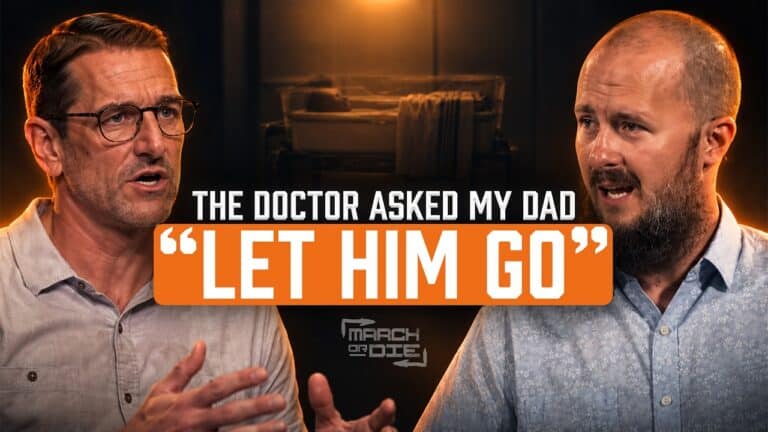
On this recent episode of the March or Die, Sean Kennard sat down with his friend Eriek Hulseman, who oversees more than sixty house churches at Church Project in Texas, to talk about what that kind of community actually looks like in 2026. The conversation lands on a hard truth most men avoid until the moment they can no longer pretend they are fine.
Biblical community is the network of men close enough to carry you when the day comes you cannot carry yourself. A small group penciled into the calendar does not qualify on its own. And that day is coming.
The Default Setting Is Lone Wolf, and It Kills Men
"There's no great examples of lone wolf Christians out there," Eriek says. "It never ends good."
He is right, and scripture is consistent on this. The first thing God called not good was a man alone (Genesis 2:18). The pattern from Pentecost onward is the same. The early church met in temple courts and house to house, sharing meals, possessions, prayer, and discipleship (Acts 2:42-47). For the early church, community was the structure everything else grew out of.
The modern version has drifted. Most churches sort men into rooms with people who look just like them. Twenty-somethings with twenty-somethings. Young couples with young couples. Empty nesters with empty nesters. It feels easier. It is also flat.
"If you're all 20 somethings together, you don't know what you don't know," Eriek says.
A man cut off from older men loses access to wisdom that took decades to earn. A man cut off from younger men loses the chance to pour anything forward. Both versions stay stuck. The strong cluster Sean and Jeremy describe in The Lone Wolf Mentality Is Killing You starts here, in the small choice to stay comfortable instead of building something cross-generational.
Proximity Is Not Optional
Eriek pastors a house church that includes people in their seventies and people in their twenties. Different stories. Different decades. Same zip code.
That last part matters more than most men realize.
"You need people close by in your time of need," Eriek says. "Sometimes the biggest thing you need is someone to be with you. Not answering your questions. Not solving the problem. Just being present."
A phone call helps. A text reminds. A man who lives twenty minutes away can show up at the hospital. That is a different category of friend, and most men do not have one.
Sean knows this from inside his own season of illness. The community that has carried him through the last year has not been the men who could call and pray. It has been the men who could drop what they were doing, drive over, and stand in the room. Biblical community is built before the crisis arrives, in proximity, week after week. By the time the crisis lands, it is too late to start.
The Three Marks of a Healthy Community
Eriek names four characteristics of a community that is actually doing what scripture describes.
Authenticity. Men share their struggles and their sin out loud. The room is safe enough to be honest in, and honest enough to push back when honesty calls for it.
Prayer. A real prayer life, sustained, in and outside the weekly meeting.
Discipleship. Men are learning from older men and pouring into younger ones. The wisdom does not erode into vapor. It moves.
Growth. The community does not turn inward. It serves, evangelizes, multiplies, and refuses to become a clique with a Bible study label on it.
If those four marks are not present, the room is a fellowship hour wearing the wrong nametag. Watch for them honestly.
Why Men Resist (and Pay for It)
Most men do not avoid community because they have not heard about it. They avoid it because it costs something. Vulnerability. Accountability. The willingness to be on the mat.
"There might be a reason why people don't want to be in community," Eriek says. "That might be that they don't want to be held accountable."
Sean takes the point further into the personal. For thirty-six years he was the mat carrier. The strong one. The friend who broke through the roof for everyone else. He admits, on the show, that part of why he held that role so tightly was to avoid ever needing the mat himself.
"If you collapsed tomorrow, who are the four men who would carry your mat?" That is the question the episode keeps returning to. The honest answer for most men is shorter than they want to admit.
The cost of staying alone is not visible in any one moment. It compounds. The marriage runs harder. The walk with Jesus thins out. The first real crisis hits a man with no one trained to lift his arms. (For more on building the inner steadiness that lets a man receive help instead of hide from it, see How to Lead When You're Falling Apart Inside.)
How to Step In, or Build It
Find a church that takes community seriously and step into the first group you can. The QR code, the sign-up table, the workout group, the men's gathering. The first step is the worst one. Take it anyway.
If the church does not have what scripture describes, build it. Four or five men. Scripture and prayer. Same town, same week, every week. Eriek's framing is simple. "If it's not there, it's up to you to do it." The church is not responsible for handing community to a passive man. He is responsible for forming it.
Aaron and Hur did not wait for Moses to ask. They saw the need and stepped in (Exodus 17:12). That is the posture of a man in real community, and the posture of the men who will surround him.
Keep Marching, Together
You were never meant to do this alone. The men who survive the long fight have men beside them. The men who collapse usually collapse out of sight, with no one close enough to notice in time.
Stop hiding inside your usefulness. Build the brotherhood now, before you need to be carried.
Join the brotherhood of men learning to fight, lead, and live with conviction inside Men of Action.Check out the companion article: https://marchordie.com/articles/why-men-dont-have-friends-anymore-and-what-biblical-brotherhood-actually-fixes/ Read Less
Brotherhoood
Episode 264
What You Did Is Not Who You Are: Dagan Van Oosten on Identity, Family, and Life After the Uniform
A Sergeant Major retires on a Friday. Flowers, ceremony, the whole formation stands at attention. The man is a legend in the unit. The next... Read More
A Sergeant Major retires on a Friday. Flowers, ceremony, the whole formation stands at attention. The man is a legend in the unit. The next Monday, a brand new PFC reports to that same unit and has no idea the Sergeant Major ever existed.
That story is one Dagan VanOosten tells on a recent episode of the March or Die podcast. He spent twenty-something years in the Marine Corps and the contracting world. Scout Sniper. Quantico Sniper School instructor. Recon Marine. Fourteen years on contracts overseas. He watched that retirement ceremony as a young instructor and felt something shift inside him.
"This machine is never going to love me the way I love it."
Dagan has watched enough men come and go from the unit to know that. The institution that defines a man's identity today is built to replace him on a Monday. That is what institutions do. They run on continuity, not on memory.
Life after the military is the chapter that begins the moment the institution stops needing the man. Most veterans do not plan for it. The military spent years teaching them to plan everything else.
This article is the case for treating life after the military like a mission. Not as a hope. Not as a hand-wave. As a planned operation, run with the same discipline a veteran applied to every other operation in his career.
The Mistake Most Veterans Make About Life After the Military
Most service members run a single planning loop the entire time they wear the uniform. The unit assigns a mission. The team plans it. The team executes it. The team debriefs. The next mission shows up in the inbox.
The day the uniform comes off, that loop ends. Nobody assigns a mission. Nobody hands down an objective. Nobody puts a five-paragraph order on the desk. For the first time in years, the man has to generate the operational picture himself.
Most do not.
The default assumption is that life after the military will figure itself out. The new job will appear. The new identity will form. The marriage will adjust. The kids will adjust. The community will be there.
It does not work like that. The veterans who transition well are the ones who treated life after the military as the most important mission of their career and started planning it years before separation. The veterans who transition poorly are usually the ones who waited until the retirement ceremony to think seriously about what came next.
Dagan watched both kinds of men come through Quantico. He decided early on which kind he wanted to be.
"It was always kind of having that, yeah, you've got your three and five meter targets. But what's two and three years down the road gonna look like? Let's start laying the groundwork to make sure those are successful times."
That principle is what the rest of this guide unpacks. Plan the life that comes after the military the way the military trained you to plan a patrol.
Why Mission Planning Works for Civilian Life
Mission planning is a transferable skill. Most veterans have not been told that.
The structure is the same. There is an objective. There are resources. There is a team. There is terrain. There is a timeline. There are obstacles. There is a desired end state. Whether the operation is a presence patrol, a counter-IED mission, or starting a small business in a state the operator has never lived in, the underlying logic is identical.
Dagan put it plainly. "It's mission planning. You can literally apply the mission planning process to anything."
Most veterans struggle in transition because they assume civilian life is supposed to feel different. Softer. More flexible. More self-directed. So they put the planning skill on the shelf and try to navigate the next chapter on instinct.
Instinct does not work in unfamiliar terrain. It never has. The veteran who treats his transition the way he treated his deployment will outplan, outmaneuver, and outlast the veteran who is hoping it works out.
What follows is a five-step framework for applying mission-planning logic to life after the military. Dagan articulated the underlying principle in episode 264. The structure below is one way to operationalize it.
Step 1: Define the Objective by Running the Tombstone Exercise
Every mission starts with a clearly defined objective. The same is true for life.
The objective for life after the military lives deeper than a job title or a retirement income or a zip code. The objective is the kind of man the veteran wants to become before he dies, and the kind of legacy he wants to leave behind.
Dagan recounts a moment with his counselor that defined his own objective. The counselor asked, "If you were to die tomorrow, what would it say on your tombstone?"
Dagan listed his accolades. Sniper. Recon. The patches and qualifications and units. The counselor pushed back. "Those are things you did. They are not who you are."
The exercise is simple. Sit down with a piece of paper. Write down the words that should appear on a personal tombstone. Strip out every job title, every unit, every qualification. What remains is the objective.
For Dagan, the answer eventually became three words. Husband. Father. Friend. Everything else in his post-military life now serves those three words.
Most veterans skip this step. They start by asking what job they should take after the military. That is the wrong starting question. The job is downstream of the objective. The job exists to serve the man on the stone.
Until the objective is defined, every other step in the plan is operating without a target.
For more on the identity layer underneath this exercise, read the companion piece, What You Did Is Not Who You Are: Dagan VanOosten on Identity, Family, and Life After the Uniform.
Step 2: Conduct a Leader's Recon of the New Terrain
A patrol leader walks the ground before the operation when he can. He learns the lay of the land. He notices the terrain features that do not show up on the map. He talks to the units already operating in the area.
The same applies to life after the military.
The civilian world is unfamiliar terrain to a man who has spent ten or twenty years in uniform. The ranks are unspoken. The communication norms are different. The accountability standards are looser. The pace of decision-making is slower. The vocabulary is mismatched. A veteran who shows up to his first civilian job thinking the military skill set translates one-for-one is going to learn the hard way that some things do not.
The recon happens before the transition, not after.
In practice, that looks like specific actions. Talking to veterans who have already moved into the industry the man is considering. Reading the trade publications of that field while still in uniform. Taking certifications, classes, or licensing exams during off-duty time. Volunteering or interning in adjacent civilian environments to learn the unspoken rules. Sitting down with a financial planner who works specifically with transitioning service members.
Every unit has a leader's recon protocol. The same protocol applied to civilian life is the difference between a planned arrival and a confused reaction.
Step 3: Build the Team
No mission runs solo. The veteran who pretends he can navigate life after the military without a team will fail the same way a fire team operating without communication fails.
Dagan was clear about this. The single biggest factor in his own ability to transition multiple times across his career was the network of people around him. Family who served. A wife who was a Marine. A brother and sister who were Marines. A father and uncles who could relate. A small circle of teammates from the unit who stayed in touch.
"It's a constant conversation," he says. "We have that kind of baked-in support structure to where at any given time and place, you've got somebody you can talk it out with if you need to."
Most veterans entering transition do the opposite. They isolate. They tell themselves nobody understands what they have been through. They pull away from the men who do understand because the conversations feel too heavy. They pull away from the civilians around them because the conversations feel too shallow.
That isolation is the first symptom of a transition starting to fail.
The team for life after the military looks like a few specific roles.
A spouse who knows the full story. A small group of veterans further down the road who have already been where the man is going. A pastor or chaplain who can carry weight other people cannot. A mentor in the civilian field the man is moving toward. A peer working through the same transition at the same time.
Build that team before it is needed. The veterans who try to assemble it during the transition itself usually do not finish before the wheels come off.
For more on the dangers of going it alone, see Why the Lone Wolf Mentality Is Killing Veterans.
Step 4: Plan in Phases
Mission planning operates in phases. So does a strong post-military life.
A common transition mistake is to imagine the entire next chapter as a single phase. The veteran retires, takes a job, and assumes that job will carry him to the end. Five years in, he discovers he did not actually want that job. He just wanted a job. The chapter has stalled.
Plan in phases. A simple structure works.
Phase one (0-3 months). Decompress. Reset the family. Reestablish the marriage. Get sleep. Start basic civilian rhythms. Resist the temptation to make a major life decision in this window. A wrong job taken in a hurry is harder to back out of than a slower start.
Phase two (3-12 months). Test the first move. The first job, the first business, the first volunteer role. Treat it as a probe, not a permanent placement. Gather information. Adjust.
Phase three (1-3 years). Commit to the right move. By now the recon has been done, the early tests have been run, the family has stabilized. Make the larger commitment. Buy the business. Take the senior role. Start the ministry. This is the phase where the longer-term identity gets built.
Phase four (3+ years). Pour into the next generation. Mentor younger transitioning veterans. Lead at church or in the community. Build something that outlasts the man.
Each phase has its own objective. Each phase has its own metrics. Each phase ends with a debrief and a course correction. That is how military planning works. That is how life after the military should work.
Step 5: Find the New Mission
Every veteran needs a mission. The men who do not have one decay.
The mission does not need to look like the old one. It almost certainly will not. The mission could be raising sons who become honorable men. It could be building a business that employs other veterans. It could be teaching a Sunday school class. It could be pastoring a small congregation. It could be coaching wrestling at the local high school. It could be starting a foundation. It could be writing.
The form is less important than the function. The mission has to involve service to someone other than the man himself.
Dagan said it directly. "It's paramount to find that new purpose. I think you have to have a high degree of selflessness to enlist in the first place. So finding that new way to be selfless is everything."
Selflessness is the muscle a service member trained for years to develop. The transition is the moment to point that muscle at a different target.
Veterans who feel lost or purposeless after transition are often men who have stopped pointing their selflessness at anything. The veteran who finds someone else to serve often finds himself again in the process.
For more on the lost-and-purposeless season many veterans hit, read Why Do I Feel Lost in Life?
Faith as the Unmoving Anchor
Every plan eventually meets contact. Mission plans rarely survive first contact intact. Life plans definitely do not. Marriages hit hard seasons. Businesses fail. Health changes. Kids make their own decisions. Friends die.
The plan is the route. The anchor is what stays steady underneath the plan when the plan changes.
Jeremy puts it plainly in the conversation with Dagan. "Having faith in a God who creates you means whatever else happens in my life, there is that which does not change, that which does not move. And that allows me to then go, okay, how was I created? What was I created to accomplish? And I can do that anywhere."
A man who knows he was created on purpose, by a God who does not change, is not destabilized when the plan does. He can lose the title and not lose himself. He can lose the income and not lose his calling. He can lose the unit and not lose his identity.
That kind of anchor is not produced by any transition plan. It is produced by surrender to Christ before the transition begins. The veterans who march well after the uniform are almost always the ones who already knew where their identity actually came from while they were still wearing it.
Psalm 139:14 says, "I will praise thee; for I am fearfully and wonderfully made: marvellous are thy works; and that my soul knoweth right well." The God who made the man is the God who carries him through every chapter, including the one that begins after the institution lets him go.
For more on rebuilding identity in Christ after service, see Why Veterans Lose Their Identity After Service (And How to Get It Back).
Common Questions About Life After the Military
When should I start planning my transition out of the military?
The honest answer is the day after enlisting. The practical answer is as early as the unit and the orders allow. The recon, team-building, and family-prep this article walks through all benefit from years of runway, not weeks. Veterans who treat the transition as a multi-year operation tend to land better than veterans who start the week of their separation date.
What is the biggest mistake veterans make when leaving the military?
The biggest mistake is assuming the institution-given identity will keep working in civilian life. The day the uniform comes off, that identity begins to fade. The veterans who built a separate, durable identity ahead of time keep marching. The veterans who did not stall.
How do I know what career to pursue after the military?
The career is downstream of two prior decisions. First, the objective: who you want to be at the end of your life. Second, the recon: what civilian fields actually align with your skills, your family situation, and your long-term mission. The right career emerges from that combination. It rarely emerges from a job board alone.
Is it normal to feel lost or depressed after leaving the military?
A period of disorientation is normal. Persistent depression, isolation, or disconnection from family is not. The line between the two is whether the man is still building a new mission or has stopped trying. Get help early. The Mighty Oaks Foundation programs are built specifically to help veterans walk through this season with men who have walked it before.
Can faith really make a difference in transition?
Yes. The single most stabilizing factor across veterans who transition well is identity rooted in something larger than the uniform. For thousands of men who have walked through Mighty Oaks programs, that something is Christ. A man who knows he was made on purpose, by a God who does not change, is not destabilized when the title someone else gave him is taken back.
Keep Marching
Life after the military is a deployment to a new theater. Different ground. Same operator.
Define the objective. Conduct the recon. Build the team. Plan in phases. Find the new mission. Anchor in something that does not move.
The institution will move on without you. That is what institutions do. The wife at the kitchen table, the kid waiting at the soccer game, the friend on the other end of a hard phone call, the God who made you. None of them are going anywhere.
Plan for them. March forward.
Watch the full conversation with Dagan VanOosten on the March or Die YouTube Channel.
Read the companion piece on identity after the uniform: What You Did Is Not Who You Are.
The Mighty Oaks Foundation has helped thousands of veterans, active duty service members, and first responders rebuild their lives after combat and crisis. Learn more about their programs at mightyoaksprograms.org.
Ready to walk this transition with men who get it? Learn more about the Men of Action program at Mighty Oaks. Read Less
Leadership & Growth
Episode 263
Clarity Is a Leadership Obligation: Why Vague Communication Costs You the Room
A father is driving home with his 14-year-old daughter when his boss calls. The boss talks for almost twenty minutes on speakerphone and says nothing.... Read More
A father is driving home with his 14-year-old daughter when his boss calls. The boss talks for almost twenty minutes on speakerphone and says nothing. When the call ends, the daughter looks at her dad and says, "That was the most inefficient conversation I've ever heard." Then she asks, "When are you going to quit?"
The man behind the wheel is Justin Atherton, a 20-year law enforcement veteran, former SWAT operator, training lieutenant, and now author of How to Get to the Damn Point. The chief on the other end of that call held a high-ranking position. He had authority on paper. What he did not have, by the end of those twenty minutes, was respect from a teenager listening in the passenger seat.
Most leaders lose the room the same way. Not in a single failure of vision, but in a long erosion of clarity.
Vague Language Is Rarely an Accident
The instinct in most teams is to assume that unclear communication is a skill problem. People just need to learn to be more articulate. Justin pushes back on that.
"When you can't give clear, concise communication, sometimes it's on purpose. It's because I don't want to be held accountable for what I say."
That is the part most leaders will not say out loud. Vague language is often a defense mechanism. If the words have no edges, the speaker cannot be measured against them. "We'll see." "I'll circle back." "Let me look into it." Each phrase keeps the door propped open, which means nothing has actually been promised.
The cost is trust. The team learns that what was said in the meeting is not what will happen after the meeting. They stop asking. They stop expecting. They start filling in the gaps with their own assumptions.
Abstract Words Are Where Performance Reviews Die
Justin makes a sharp distinction between concrete and abstract language. A leader can use either. Most use the wrong one and create confusion they never intended.
Imagine a performance review that reads, "Sean has demonstrated a bad attitude this quarter."
What does attitude mean? What does bad look like? The employee receiving that review has no behavior to change because no behavior has been named. The leader feels like clarity has been delivered. The employee walks out with a vague accusation and no path forward.
Compare that with: "We need you to engage in team meetings instead of staying silent. We need you to stop interrupting other presenters mid-sentence." Same conversation. Now there is something to act on.
Justin's rule is simple. If a word can be misinterpreted, it probably will be. Determined. Engaged. Better. These are conceptual words. They feel meaningful. They produce no action. Replace them with something a video camera could record.
The WAVE Method
Justin teaches a four-part framework for self-auditing communication. He calls it WAVE.
Words. Watch for three categories. Absolutes (always, never, every) that almost never line up with reality. Equivocations (maybe, sort of, we'll see) that signal a refusal to commit. Stop-action verbs (try, plan to, want to, need to) that announce failure before the work begins.
Awareness. Catch it in the moment. The subconscious is always listening. A leader who tells himself "I'll try to make it to the gym today" is rehearsing his own out. "I will go to the gym today" rewires the same sentence into a commitment.
Verify. Audit written communication harder than spoken. Email, text messages, proposals, marketing. The recipient reads in their own mood, with no facial expression to lean on. Re-read every important email until vague language has been removed.
Engage. Bring an accountability partner into the process. A spouse, a coworker, a teammate who is willing to say, "You just said 'try.'" Real change requires friction from the outside.
Say the Point First
If the WAVE method is the audit, the daily habit is even simpler. Say the point first.
Most people bury the point. They open with backstory, context, a polite warm-up, a few qualifiers, and finally arrive at what they meant to say five minutes earlier. The room is already lost.
Justin teaches a Point > Why > Context formula. Lead with the point. Add the reason. Provide context only if context is needed. The polite sandwich, where correction is sandwiched between two slices of compliment, fools no one. The team member knows the hammer is coming. He just has to sit through three minutes of nervous warm-up to get to it.
Be human at the end of the conversation, not the front. Direct does not mean cold. It means the person across from you knows what is being said.
Clarity Is the Cost of Leading
Vision without clarity does not move anyone. The team that does not understand the order does not execute the order. The family that hears "we'll see" learns that Dad's word is a placeholder. The marriage that runs on assumed definitions runs into the same fight every month.
Clarity is not a personality trait. It is a discipline. It can be trained, audited, and sharpened. It also has to be chosen, every conversation, by the person who is responsible for the outcome.
For the men called to lead families, teams, businesses, and ministries, that responsibility does not get delegated. Say what needs to be said. Say it clearly. Then stand on it.
Pick up Justin's book, How to Get to the Damn Point, on Amazon:
Ready to lead with conviction and clarity? Learn more about the Men of Action program Read Less
Leadership & Growth
Episode 262
How to Lead When the World Feels Out of Control
There is a cloud over most of the world right now. Wars near and far. Political fracture at home. Alliances that stood for generations coming... Read More
There is a cloud over most of the world right now. Wars near and far. Political fracture at home. Alliances that stood for generations coming apart. A news cycle that never ends, pumped into every pocket. The anxiety is no longer personal or local. It is ambient.
On this episode of the March or Die podcast, Jeremy Stalnecker asks the harder question: how does a man lead well when the world feels like it is unraveling?
"It is the responsibility of the leader during moments of local crisis, personal crisis, or global crisis to anchor themselves and those that they lead to the unchanging nature of God," Jeremy explains.
That is the job. Anchor yourself. Anchor the people under your care. Not to an outcome, not to a feeling, not to a political result. To the unchanging character of God.
Here is how that gets practical.
This Is the World. It Has Always Been the World.
Most of the panic of this current moment runs on a quiet assumption: that this is somehow unprecedented. That the chaos outside the window is a deviation from the norm.
It is not. "And ye shall hear of wars and rumours of wars. See that ye be not troubled, for all these things must come to pass, but the end is not yet" (Matthew 24:6).
Read history. Peace, then a world war. Peace, then another. Solomon already wrote the verdict in Ecclesiastes: there is nothing new under the sun. A fallen world produces what a fallen world has always produced.
That truth is not a comfort. It is a foundation. A leader who stops being surprised by brokenness stops being destabilized by it.
Anchor Your Mind
Anxiety is almost always the byproduct of fixing the mind on what the mind cannot control.
Wars ten thousand miles away. A decision in Washington. A headline written to agitate. None of it sits inside a man's hands. And yet, for many, it sits on the chest all day.
Jeremy's direction is blunt. Control what can be controlled. Turn the rest over.
"That will keep him in perfect peace whose mind is stayed on thee, because he trusteth in thee" (Isaiah 26:3).
A mind stayed on God. A posture of trust. That is where peace comes from.
Practically, this means limiting the intake. Not burying one's head, but refusing to consume chaos by the hour. The leader who spends three hours a day absorbing content he cannot influence is not more informed. He is more eroded. (The same discipline holds when the pressure is personal. See leading through adversity.)
Be a Non-Anxious Presence
Atmosphere is caught, not taught.
A home takes the emotional temperature of its parents. A team takes it from its leader. A unit takes it from its chief. People under a man's care are always reading him to decide how they should feel.
Jeremy tells the story of a small child who trips. The fall is the same. But the reaction changes based on what the parent does. If the parent panics, the child cries. If the parent says, "Get up, let's go," the child usually does.
The grown version is identical. The people a man leads are watching to see if they should be afraid.
"Be careful for nothing, but in every thing by prayer and supplication with thanksgiving let your requests be made known unto God. And the peace of God, which passeth all understanding, shall keep your hearts and minds through Christ Jesus" (Philippians 4:6-7).
A non-anxious presence is not a mask. It is not pretending the world is fine. It is what shows on a man's face when he has already taken the weight to God and left it there. Peace, like fear, is contagious. A leader gets to decide which one spreads.
Lead Small in Light of the Big
The last move is to refuse the trap of paralysis.
There is a temptation, when everything feels large, to do nothing because nothing we do feels large enough. A man stops investing in his kids because he is consumed by a war he cannot end. A man stops showing up for his team because he is arguing online with strangers.
Paul's instruction to believers in the Roman Empire, a moment as chaotic as any, was straightforward. "Study to be quiet, and to do your own business, and to work with your own hands" (1 Thessalonians 4:11).
Lead the family in front of you. Lead the team that reports to you. Lead the men on either side of you at church. Steward what God has actually placed in your hands. Let Him be God over the rest.
The Victory Is Already Settled
"These things I have spoken unto you, that in me ye might have peace. In the world ye shall have tribulation. But be of good cheer. I have overcome the world" (John 16:33).
Global anxiety is not going away before Christ returns. That is the honest read. But the outcome is already written, and the men who know it get to lead from the other side of the fear.
Anchor yourself. Anchor your people. Join the brotherhood forming inside Men of Action. Keep marching.Reach the companion article written by Jeremy: Leading Through Adversity Read Less
Latest Episodes
01:00:21
Brotherhoood
What You Did Is Not Who You Are: Dagan Van Oosten on Identity, Family, and Life After the Uniform
Marine Scout Sniper Dagan Van Oosten on the counselor's tombstone question that rewired his identity,...
Read More →
00:44:56
Leadership & Growth
Clarity Is a Leadership Obligation: Why Vague Communication Costs You the Room
Most leaders don't lose authority because they lack vision. They lose it because they lack...
Read More →
00:40:26
Leadership & Growth
How to Lead When the World Feels Out of Control
Global anxiety is not a leadership problem to solve. It's a presence to steady. Jeremy...
Read More →
00:39:42
Faith & Purpose
Define Your Life: Four Questions That Cut Through the Drift
You can be busy, successful, and still feel like you're drifting. Jeremy Stalnecker walks through...
Read More →What Does The Bible ACTUALLY Say About Tattoos?
Watch NowMost Popular Hits
-
1
Biblical MasculinityElite Preparation, Elite Attitude, Elite Effort = Elite Outcomes | March or Die
Episode 260
-
2
Faith & PurposeWhat Biblical Community Looks Like (And Why Most Men Don’t Have It)
Episode 265
-
3
BrotherhooodWhat You Did Is Not Who You Are: Dagan Van Oosten on Identity, Family, and Life After the Uniform
Episode 264
-
4
Leadership & GrowthClarity Is a Leadership Obligation: Why Vague Communication Costs You the Room
Episode 263
-
5
Leadership & GrowthHow to Lead When the World Feels Out of Control
Episode 262